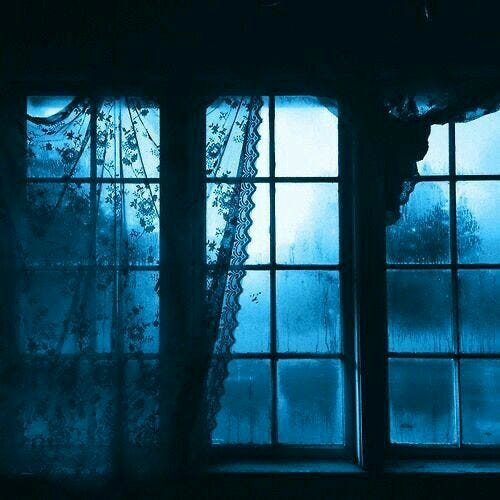
how do you know when the curtains aren't just blue?
written while contemplating the loss of media literacy and anti-intellectualism

One of my favorite things to do while I have some time for myself is to go to YouTube, look up songs I enjoy, and scroll through the comments.
For some songs, such as Foundations of Decay by My Chemical Romance, the comments are full of people grateful and excited for new music coming from a band that had been broken up back in 2013. For others, like Creatures X: To The Grave by Motionless in White, people discuss their decade-long love for the band while simultaneously applauding the vocals as performed by both the band's lead vocalist as well as lead guitarist.
For songs that have a story to follow, it isn't uncommon to find people discussing (and/or arguing about) the "plot" of the song. This is especially common with music videos on YouTube. Sabrina Carpenter's music video for her song Taste and Halsey's music video for Ego have commenters raving about the story arcs happening within the videos. For the Taste music video, people excitedly mention the Easter eggs and references to Sabrina's other music videos, Please Please Please and Espresso, that highlight the "Sabrinaverse" (as one commenter titles it) while also mentioning scenes that are reminiscent of films like Death Becomes Her from 1992. Ego also has similar comments, mentioning that the music video's reference to Mr & Mrs Smith (2005) helps portray the song's meaning of an internal fight with oneself and their titular ego.
However, I have come to notice a distressing trend in some commenters in the comment sections of many songs. Take, for example, this comment from the lyric video for Luvcat's He's My Man:

The replies under this comment, of course, have many people sharing their thoughts about how they interpret the song. Some discuss the horrors of the song’s narrator being a traditional housewife and realizing she doesn’t want to be that while others offer simpler answers like "she's lonely and wants her husband to stay home". The answers are not so much concerning on their own, but they bring up a concerning question: Why do you want to know what the song is “really” about?
Plenty of other commenters on the same video discuss their own interpretations, but immediately follow up their thoughts with confirming that it's only their interpretations and that they might not be "correct". But if it's a personal interpretation, then why does it have to be "correct"?
Last month, I published a piece talking about my experience working with high school kids and seeing firsthand just how much the American (specifically Texan) school system killed creative writing. I pointed out a specific phenomenon that really bothered me:
We had a pre-planned presentation given to us by the faculty in charge of the day’s activities, and for some reason, they felt dystopic, filled with questions begging for the high schoolers to discuss feelings and thoughts and emotions of the poetry we read to them. And when our discussions started, the topics waded between those and form; diction paired with personal history, a student talking about being from the northwest comparing it to the descriptions of one of the poems we shared, using academic terminology while looking to me and my fellow presenter with hope that they weren’t wrong.
There it is again, the obsession with being right. The need to be able to back up emotion and feeling with contextual evidence that you can spew out like a graduate student defending their thesis. Why do you need to be right in what you’re feeling? Is it not enough to just feel something and tell people about it?

I believe this has roots in the social media age and the death of media literacy.
Cut me off if you’ve ever heard this one before:
“Sometimes, the curtains are just blue.”
Does that sound familiar to you? It should, if you’re a writer who has been on social media at any point in time in the last decade. A long time ago, people on the internet tried to make a point that your English teachers were all making a big fuss about nothing, and that sometimes text just says or does stuff and doesn’t mean anything more by it. Your high school English teacher will try to convince you that the color of the curtains are meant to show the emotional turmoil of a character going through something intense, but the author can tell you outright that the curtains are just blue. No further rationale, no further explanation—sometimes, the curtains are just fucking blue.
I’m not trying to say that this isn’t the case. When looking at some stories, looking too far into it gets you further away from the story it was trying to tell. Since I started this discussion with talking about music, let’s continue using music that tells a story. I haven’t talked about Motionless in White enough yet, so let’s use two songs from their album Reincarnate from 2014.
Let’s look at this verse from the song Dead as Fuck:
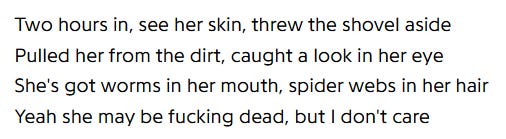
It’s pretty cut and dry, right? The story is about necrophilia. You can look through the song’s lyrics on Genius, and it all says the same thing. In this case, the curtains are just blue—the narrator is just describing (in gruesome detail) having sex with a corpse. Simple, easy, and hard to read as much more than what it sets on the table.
Then you get to a song with a title like Everybody Sells Cocaine, and you probably think to yourself, “Well, it’s probably just about doing drugs, right? This is a metal band from the 2010s, after all.”
But then you look at lyrics like this:
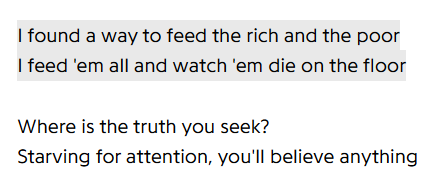
And the curtains aren’t just blue anymore. It’s not about doing drugs, especially because their lead singer famously is straight-edge and has been since before Motionless in White took off. You can argue that you can write a story about drug use even if you haven’t done it yourself, but in the case of Everybody Sells Cocaine, its lyrical content shows that it’s about something else—something more. But what is it about? If the curtains aren’t just blue, then what is the purpose of telling us about them at all?
A well-known thing about Chris Motionless (the aforementioned lead vocalist) is that he doesn’t like the whole “inspirational speech” thing that was huge back in the 2010’s. If you had half a braincell in the 2010’s, I’m sure you remember it: all kinds of celebrities and musicians did the whole, “You’re going to make it through this!” “Don’t end it, you’re not alone!” “I’m just like you! I’ve been depressed too!” schtick. Remember all those “not all heroes wear capes” edits?

Yeah, Chris didn’t like any of that shit. Back in 2013, he made a Tumblr post going into detail about how he thought those sentiments were disingenuous and shallow, and how it inherently belittled people who were suffering by not letting them take initiative and control in their own recovery. Take this in combination with how I told you the album Reincarnate, where the song Everybody Sells Cocaine comes from, came out in 2014 (less than a year after the Tumblr post was made), and now we have a bigger picture of what the song itself means. It’s not about selling drugs, it’s about selling yourself and making everyone get addicted to what you can tell them to get a quick buck.
I know that I probably didn’t need to explain that to most of you who read this. This is Substack, and whether you’re subscribed to me or someone else, I imagine that you understand this very simple concept and have since before you started reading…
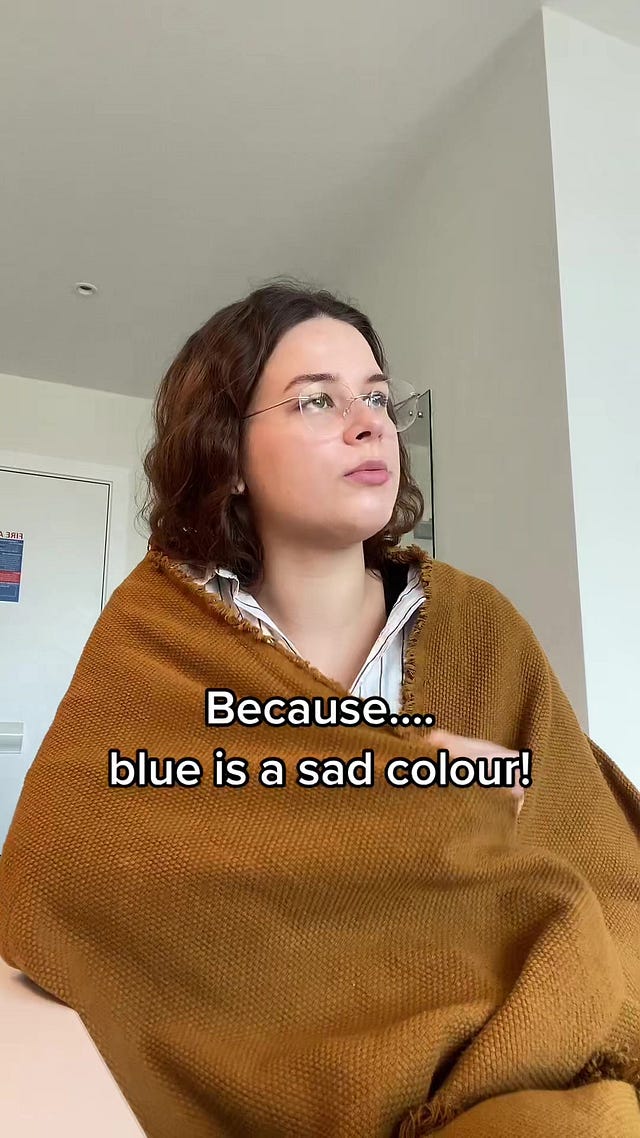
…But I can’t say that for everybody. Take this TikTok from 2022 for example (yeah, I know she’s holding a Colleen Hoover book, but stay with me here):
 Tiktok failed to load.
Enable 3rd party cookies or use another browser
If you go into the comments of that video, you get a lot of people either complaining about the death of media literacy, or people saying that they want to send this video to their English teacher, or this person who made a funny joke even though it goes against everything I’m arguing about right now:
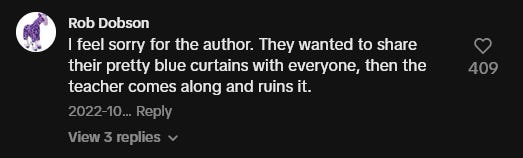
And with every person who claims “well, sometimes the curtains are just blue”, they’re missing a big point in what their teachers are actually trying to teach them. Yeah, sometimes the curtains are just blue. Other times, there is meaning behind why the curtains are blue.
Can you pick out the difference between the two?
Well, if you’d stop saying that “sometimes the curtains are just blue”, maybe you could. Actively fighting against literature and art, especially through education, is quite genuinely anti-intellectualism—and I do not say that lightly. Wanting for the world to have a hivemind and monolithic identity where everyone thinks and acts the same, rather than having to think for yourself and have a separate identity that is forged by your own life experience and thoughts, is dangerous because it inherently isolates and exiles those who are inherently “different” from the monolith. It’s racist, it’s sexist, it’s homophobic, it’s transphobic—anti-intellectualism is inherently bigoted, and it’s always been built like that. Just because a baby-faced cheerleader named Stacy in the ninth grade decided that she doesn’t want to think hard about racism and sexism while reading Of Mice and Men by John Steinbeck to “stick it to the man” of her public high school’s authority figures doesn’t make her any less of an anti-intellectualist.
I’ve said it before, though probably not on Substack yet, so it bears repeating: just because you think you’re on the “in” crowd with the oppressors of other people doesn’t mean they’re going to find every way to push you out and oppress you, too. We all know how conservatives reacted when 45 stopped being on “their” side after getting re-elected. He was never on their side in the first place, but they thought he was, and that was enough for them.
But these things have to start somewhere. People aren’t born evil or stupid, they’re forced that way to fit a form that benefits either themselves or someone else. People aren’t born anti-intellectualists, they’re made that way because it benefits oppressors to have an uninformed populace that can’t tell or just doesn’t care that they’re uninformed. Oppressors keep things bad so that it will break those who are oppressed down into submission.
“Sometimes, the curtains are just blue” is baby’s first instance of anti-intellectualism. It latches onto something that people already think is difficult (i.e. critical thinking and media literacy) and gives them a way to bypass it and claim it doesn’t matter. But there is a reason that teachers in your middle and high school are trying to teach you these things. They know it’s hard—that’s why there’s a fucking class about it! That’s why they spend several years teaching you these things!
It’s not about blue curtains. It’s about knowing when the curtains are blue. It’s about being able to ask, “Why is this detail important to know?” and actually have a fucking answer instead of brushing it off and saying, “Well, the author wants to let us know they have blue curtains.”
You can have your own thoughts and feelings about stuff. You don’t have to cling onto what is the “correct” answer—you’re allowed to think about things how you want to think about them. Maybe He’s My Man by Luvcat is about a housewife wanting to get out of her abusive relationship, or it’s about an obsessive wife who loves her husband a little too much, or maybe it’s something else. It’s a song, and it’s up to you to decide what story you like best for your own enjoyment.
You wanna know the really funny thing about me writing all this? The curtains in my bedroom are blue. I wrote this entire post sitting next to blue curtains and none of you knew it until now.